What do Belgium's parties propose on climate and energy in 2026?
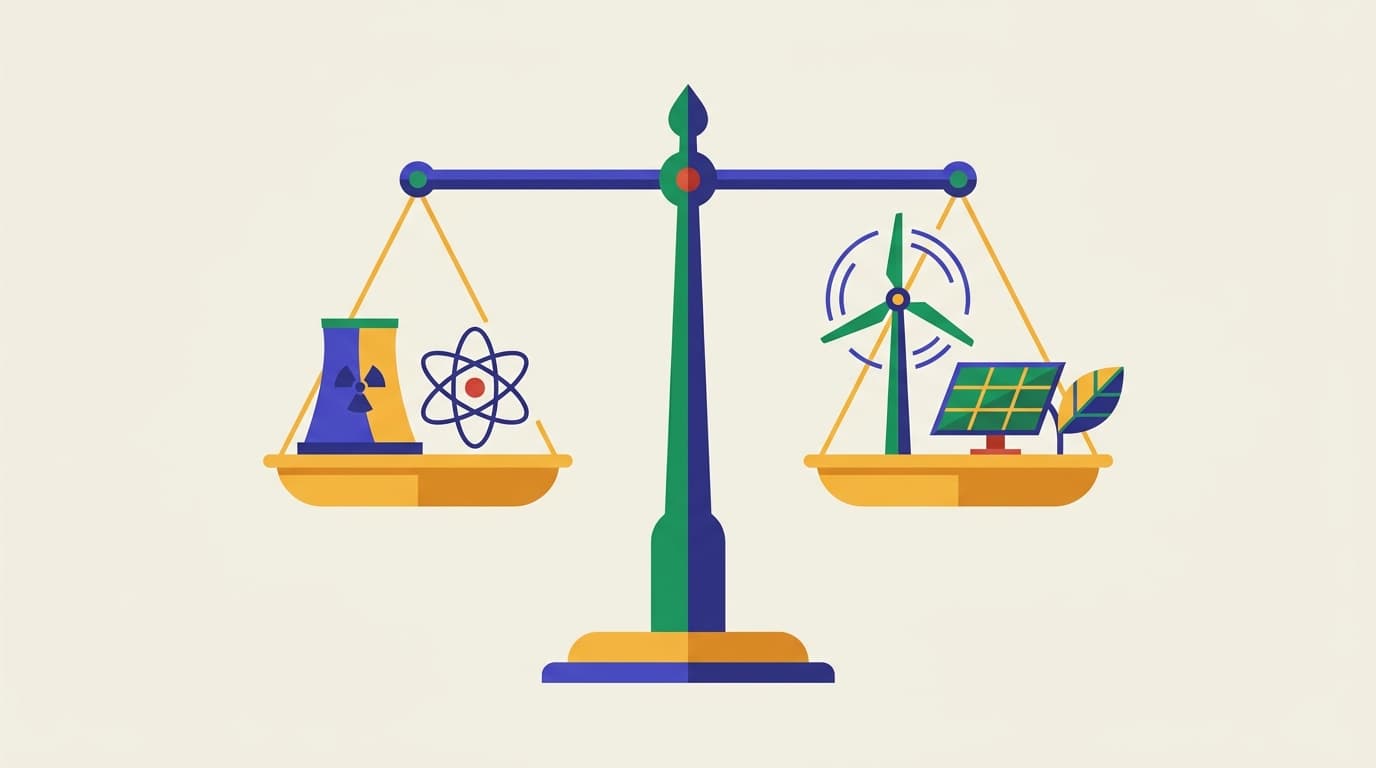
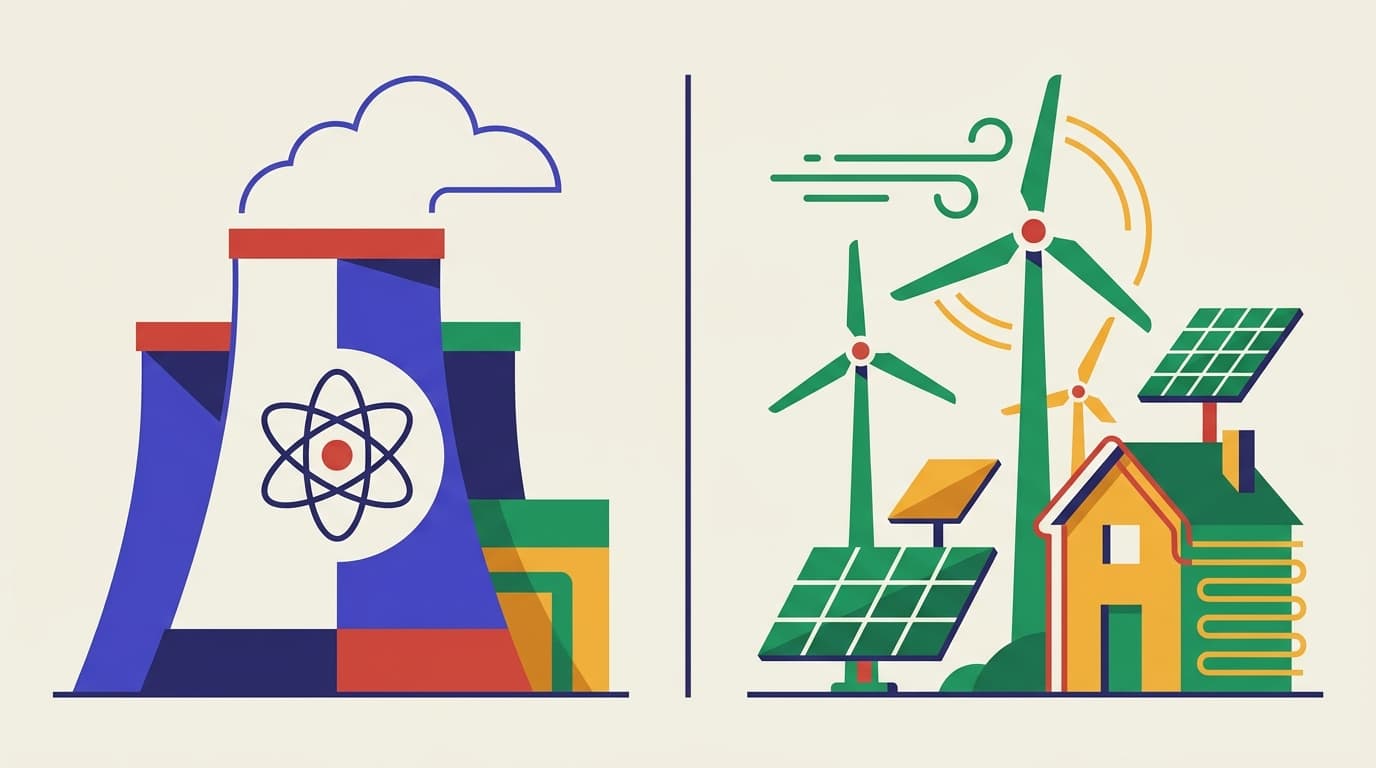
In 2026, Belgium's ten main parties fall into two families on climate and energy. On one side, the N-VA, MR, Open VLD, CD&V and Les Engagés bet on relaunching nuclear power and technology neutrality: extend the reactors, study new ones, and let the market choose low-carbon solutions. On the other, the PS, Ecolo, Groen and the PTB·PVDA want a transition driven by public investment, with a clear course set on renewables. Vooruit, in the majority, backs both nuclear power and ambitious public funding.
This dividing line does not pit a "good" manifesto against a "bad" one. It pits two answers to the same question: how to decarbonise Belgian electricity while keeping bills and supply under control. The first relies on nuclear and the market. The second relies on public planning and renewables. Both camps say they want to meet the climate targets; they simply pull different levers.
By the numbers, the framework is set. In 2023, 14.7% of energy consumed in Belgium was renewable, and the national plan (NECP 2025) targets only 20.4% by 2030, below the EU indicative target of 33%. That gap, and the end of the nuclear phase-out decided by the Arizona government, shape the whole debate this year.
How do you read these positions without taking sides?
Each party gets a sign per lever here: a green + when it clearly backs that approach, an amber ~ for an intermediate or conditional position, a red − when it opposes it. This system replaces stars or marks out of 5, which would suggest a moral ranking.
The key point: no column designates a "good" party. A party marked with a + on relaunching nuclear is often marked with a − on a transition through public investment, and vice versa. The two levers answer different priorities — security of supply and cost for one, speed of decarbonisation and social justice for the other — backed by different voters. Reading the table means spotting the lever each party favours, not handing out a prize for virtue.
For example, the N-VA gets a + on nuclear and a − on public funding of the transition, which it sees as bad for competitiveness. Ecolo has the opposite profile. Neither is "in the lead": they are not playing on the same field.
| Party | Relaunch nuclear power | Transition through public investment |
|---|---|---|
| Ecolo | − | + |
| Groen | − | + |
| PS | ~ | + |
| PTB·PVDA | ~ | + |
| Vooruit | + | + |
| Les Engagés | + | ~ |
| CD&V | + | ~ |
| MR | + | − |
| Open VLD | + | − |
| N-VA | + | − |
| Vlaams Belang | + | − |
Why did nuclear power return to centre stage in 2026?
Nuclear power returned to the heart of the debate because the Arizona government buried the 2003 phase-out law. In practice, the text removes any imposed closure date, makes a ten-year extension possible and opens the door to studying new reactors. It is a complete reversal of the path set twenty years ago.
On the ground, two reactors hold the attention. Doel 4 and Tihange 3, the youngest in the fleet, are extended to 2035 under the deal between the State and Engie, sometimes called "Phoenix". After a long maintenance, their restart is targeted around November 2026. Security of supply for the winter partly depends on that timetable.
For new reactors, the horizon is far more distant. According to a Tractebel study for grid operator Elia, large new units would not be operational before 2039 at the earliest, and more likely between 2042 and 2044 — provided the project is launched by the end of 2026 without any delay. Only the Doel and Tihange sites meet the technical conditions to host several reactors of more than one gigawatt. Nuclear's supporters see low-carbon, dispatchable electricity and energy sovereignty. Its opponents reply that the timetable is too slow for the climate, the cost uncertain and waste management unresolved.
Will Belgium meet its 2030 climate targets?
On the current path, Belgium will not meet its 2030 EU targets. The national energy and climate plan (NECP 2025) projects a cut of about 42.7% in non-ETS sector emissions (transport, buildings, agriculture) versus 2005, while the assigned target is 47%. The gap is not trivial: it concerns the sectors closest to households' daily lives.
On energy, the lag is sharper still. The renewable share targeted for 2030 is 20.4% of final consumption, far from the EU indicative target of 33%, while the country started from 14.7% in 2023. On 26 January 2026, the European Commission welcomed the Belgian plan's progress while finding it lacked ambition on renewables, energy efficiency, investment and coherence between the federal and regional levels.
That very gap feeds the manifestos. For the left, it proves not enough is being invested fast enough in wind, solar and insulation, and that public steering is needed. For the right, it shows the limits of binding targets and argues for a technology-neutral approach, where nuclear offsets the intermittency of renewables. The same figure thus serves two opposite conclusions — which is why it pays to compare levers rather than slogans.
What do the parties betting on nuclear and the market propose?
Centre-right and right-wing parties want to guarantee supply and control costs first, and let the market and innovation choose the technologies. The N-VA defends technology neutrality: no renewable target imposed for its own sake, but a mix combining nuclear and renewables without penalising industry. The MR puts forward "climate with security, science and innovation" and names offshore wind and solar as priorities, alongside nuclear. The Open VLD shares this market logic and fleet extension.
The CD&V and Les Engagés also back nuclear, but with caveats on public funding. Les Engagés propose, for instance, to multiply decarbonised electricity output fivefold and envisage 25% nuclear in the 2050 mix, arguing that seasonal renewables are not enough on their own. Hence their ~ on a transition through public investment: they accept some public money, but not generalised state planning.
The core argument is reliability and competitiveness: dispatchable, cheap electricity protects industrial jobs and avoids outages. The criticism, voiced by the left and environmental NGOs such as Canopea or Natagora, is that technology neutrality often serves to delay the renewable effort, and that betting on reactors available in 2042 does not cut emissions in the decade that matters most.
What do the parties wanting a publicly funded transition propose?
Left-wing parties want a State that plans and funds the transition, with a quantified course on renewables. The PTB·PVDA proposes at least 70% renewable electricity by 2030, through massive public investment, public control of building insulation and stronger public transport. The PS and Ecolo aim for 100% renewables by 2050, with Ecolo targeting 30% as early as 2030, and back a transition where "the wealthiest and big companies make the largest extra efforts".
For this camp, the right lever is not the market but public power: it is for the authorities to fund infrastructure, insulate buildings and stop the climate bill from falling first on lower-income households. Ecolo and Groen add a nuclear phase-out, which they deem too costly and too slow, preferring to concentrate every euro on renewables and energy efficiency.
The insulation example is telling: renovating the building stock at scale cuts both emissions and bills, but requires billions in upfront public money. The criticism, voiced by the right, is that this planning is expensive, adds to debt and taxation, and assumes a state efficiency that is not guaranteed. Its defenders reply that inaction would cost even more, in climate damage as in dependence on imported energy.
Where do Vooruit, the PTB·PVDA and the Vlaams Belang stand?
These three parties blur the classic left-right split on energy. Vooruit, socialist but a member of the Arizona coalition, backs both relaunching nuclear — which it voted for in government — and ambitious public funding of the transition. Hence its double +: it refuses to choose between security of supply and social justice, even if others call that contradictory.
The PTB·PVDA, to the left of the left, does not hold the anti-nuclear stance sometimes attributed to it. It criticised the rushed closure of reactors and backs keeping them open under public control rather than for Engie's profits, while aiming for 70% renewables. Hence its ~ on nuclear and its clear + on public investment: its compass is less technology than public ownership of energy.
The Vlaams Belang, for its part, combines support for nuclear with rejection of climate policies it deems costly for citizens. It defends cheap electricity and keeping the nuclear fleet, but opposes the massive public spending and binding targets the left proposes. Hence its + on nuclear and its − on a transition through public investment. Two parties can thus back nuclear for opposite reasons — an assumed industrial relaunch for one, rejection of the "green bill" for the other — without sharing anything else.
Climate and energy: what do the votes and actions say?
Beyond the manifestos, the 2026 actions confirm the dividing line. The Arizona majority — N-VA, MR, Vooruit, CD&V, Les Engagés — passed the repeal of the nuclear phase-out and sealed the deal with Engie on Doel 4 and Tihange 3. The PS, Ecolo, Groen and the PTB·PVDA, in the federal opposition, mainly contest the inadequacy of the renewable effort, each for its own reasons.
Testing promises against actions is the best antidote to electoral marketing. A party can talk about "transition" in both camps; it is the votes, the government agreement and the budgets that reveal the lever actually pulled. Vooruit's case is telling: socialist on paper, it voted to relaunch nuclear in the name of government cohesion.
To dig further, the comparator lets you put two parties side by side on climate and energy, the ranking sums up positions theme by theme, and the quiz starts from your priorities rather than a manifesto. The methodology details how these positions are gathered and remains open to challenge.
What this comparison does not settle
This table does not say which approach "works" best: the real effect of a nuclear relaunch or a public investment plan depends on future costs, energy prices, the speed of construction and European choices that go beyond Belgium alone. Nor does it factor in your situation — tenant or owner, car dependence, heating bill — which often weighs more than a national average.
So the right reflex is not to remember a winning camp, but to link each position to the lever it pulls, then to test this overview against what you expect from a climate and energy policy.
Climat & Énergie comparator
Compare the parties' positions on climat & énergie.
Compare now →
Frequently asked questions
Camille est politologue, diplômée en sciences politiques de l'UCLouvain. Elle a suivi trois campagnes électorales belges comme analyste et décortique depuis dix ans les programmes des partis, vote par vote. Sur Meilleur Parti Politique, elle traduit le jargon politique en comparaisons concrètes — sans jamais dire pour qui voter.