What do Belgium's parties propose on mobility in 2026?
In 2026, Belgium's ten main parties fall into two families on mobility. On one side, the PS, Ecolo, Groen and the PTB·PVDA want more public money for rail and public transport, and refuse the savings demanded from the SNCB. On the other, the N-VA, MR, Open VLD and Vlaams Belang bet on efficiency, budget savings and opening to competition to "do more with less". The CD&V, Les Engagés and Vooruit, in the majority, accept the savings while backing rail investment.
This dividing line does not pit a "good" manifesto against a "bad" one. It pits two answers to the same question: how to deliver smooth, low-carbon mobility without letting the state budget spiral. The first answer runs through public spending and priority to rail. The second runs through reform, competition and making the user responsible. Both camps say they want more trains on time and fewer traffic jams; they simply pull different levers.
By the numbers, the framework is set. The 2025 federal government agreement targets 30% more passengers and punctuality above 90% for rail, while demanding 675 million euros in savings from the SNCB and Infrabel between 2025 and 2029. That tension between stated ambition and imposed savings shapes the whole debate this year.
How do you read these positions without taking sides?
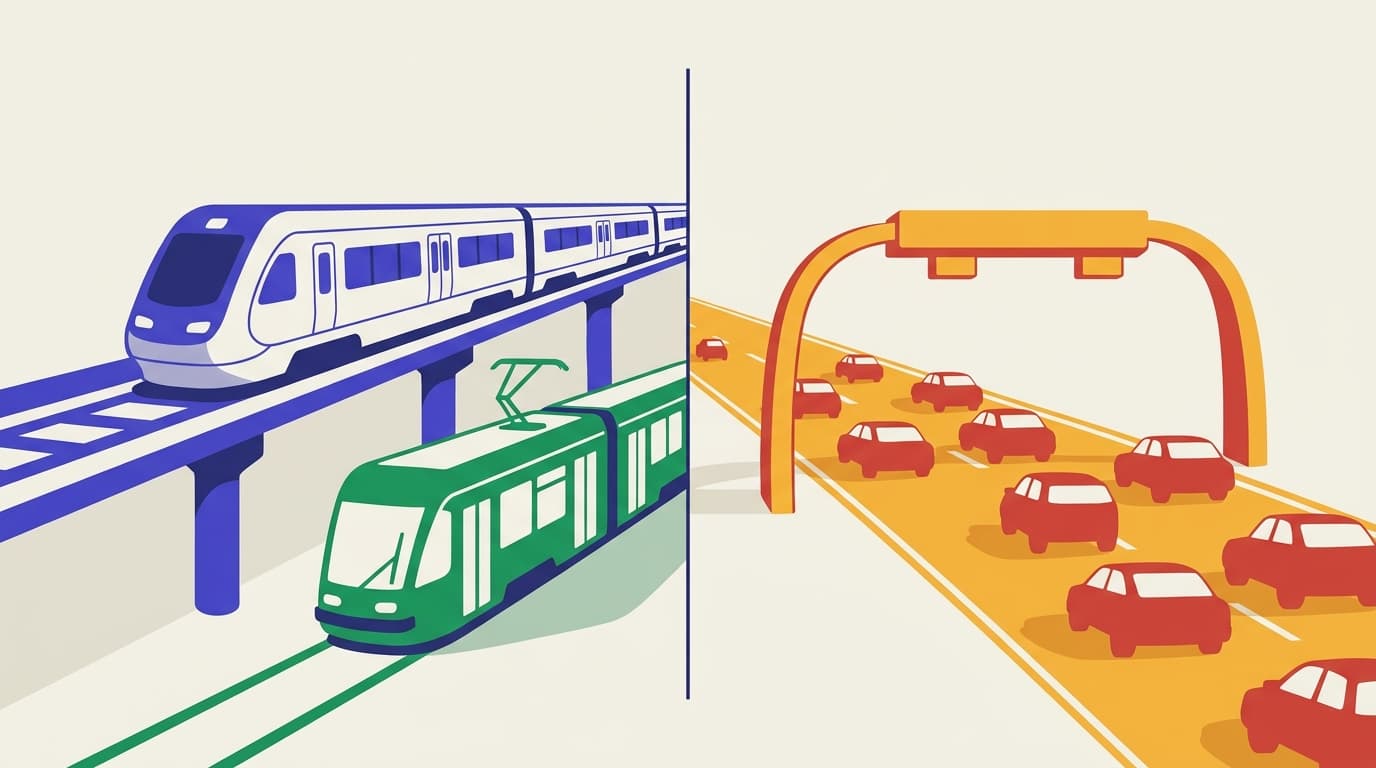
Each party gets a sign per lever here: a green + when it clearly backs that approach, an amber ~ for an intermediate or conditional position, a red − when it opposes it. This system replaces stars or marks out of 5, which would suggest a moral ranking.
The key point: no column designates a "good" party. A party marked with a + on public rail funding is often marked with a − on pricing road use, and vice versa. The two levers answer different priorities — public service and access for all for one, spending control and traffic flow for the other — backed by different voters. Reading the table means spotting the lever each party favours, not handing out a prize for virtue.
For example, Ecolo gets a + on public rail funding and a + on road pricing, which it sees as an environmental tool. The MR has the opposite profile: it defends the driver and is wary of a new tax. Neither is "in the lead": they are not playing on the same field.
| Party | Strengthen public rail funding | Price road use (kilometre charge) |
|---|---|---|
| Ecolo | + | + |
| Groen | + | + |
| PS | + | ~ |
| PTB·PVDA | + | − |
| Vooruit | ~ | ~ |
| Les Engagés | ~ | ~ |
| CD&V | ~ | ~ |
| Open VLD | − | ~ |
| N-VA | − | ~ |
| MR | − | − |
| Vlaams Belang | − | − |
Why is rail at the heart of the mobility debate in 2026?
Rail returned to the heart of the debate because the Arizona agreement displays big ambitions and heavy savings at the same time. In practice, the text targets 30% more passengers, punctuality above 90%, 50% new trains and 30% fewer cancellations by 2032 — while demanding 675 million euros in savings from the SNCB and Infrabel between 2025 and 2029.
Those savings follow a precise path: 50 million in 2025, 100 in 2026, 125 in 2027, 150 in 2028 and 250 in 2029. For the measure's supporters, a better-run operator can absorb this effort without degrading service; for its opponents, you do not run more trains on time by cutting the budget. Rail unions denounce "contradictory" objectives, and Ecolo warned about the planned closure of some twenty stopping points.
The investment example shows how complex the file is. Despite the savings, the SNCB invested more than 820 million euros in 2025, including around 350 million in renewing rolling stock and 213 million in stations. The same budget can thus fund new trains and, elsewhere, close small stops. Which is why it pays to compare levers rather than slogans.
Should road use be priced in Belgium?
Belgium already makes some road users pay, but not cars. A per-kilometre charge has applied since 2016 to trucks over 3.5 tonnes, via the Viapass system and the Satellic on-board unit, with a rate that varies by region, road type and vehicle emissions. Motorways, meanwhile, remain free for passenger cars — a rarity in Europe.
The idea of extending a kilometre charge to cars comes back regularly, more likely around 2030-2035, and clearly divides the parties. Ecolo and Groen see it as a tool to cut congestion and pollution by charging actual use rather than mere car ownership. The MR, the PTB·PVDA and the Vlaams Belang oppose it, in the name of drivers' purchasing power and of people in areas poorly served by public transport. In between, several Flemish parties say they are open to a "smart" charge provided it is budget-neutral, meaning offset by a cut in other car taxes.
The Walloon debate over a possible motorway vignette shows how sensitive the topic is: the stated aim was to make foreign users contribute without adding to Belgians' bills. Supporters of usage-based pricing see fairness and efficiency; opponents fear yet another tax that mainly hits those who have no alternative to the car.
What does the company car and mobility budget reform change?
The big shift in 2026 concerns the company car and its alternative, the mobility budget. Since 1 January 2026, a car offered under the first pillar of the mobility budget must be zero-emission, so fully electric: hybrids and low-emission models are no longer eligible for it. In parallel, the tax deductibility of hybrid company cars is kept at 75% until the end of 2027, before falling to 65% in 2028 then 57.5% in 2029.
The mobility budget itself lets an employee entitled to a company car swap all or part of that benefit for a cleaner vehicle, transport passes, a bike or a move closer to work. In 2026, its amount ranges roughly between 3,233 and 17,244 euros a year depending on the role. The Arizona government makes the offer systematic: any employer who grants a company car must now propose this alternative.
This reform crystallises the visions. For its supporters, greening the corporate fleet — nearly a million company cars are on Belgian roads — is a major climate lever that costs households nothing. For its critics on the right, forcing electric too fast penalises those who drive a lot or live far from a charger; on the left, the PTB·PVDA argues that the tax advantage on company cars mainly benefits high earners and distorts the comparison with public transport.
What do the parties wanting more rail and public transport propose?
Left-wing parties want a State that funds and strengthens the public transport offer, with rail as the backbone. The PS and Ecolo back sustained investment in the SNCB, better service in rural areas and affordable fares, and directly contest the 675 million euros in savings. The PTB·PVDA goes further still, calling for very cheap public transport, even free for some groups, funded by the community.
For this camp, the right lever is not the market but public power: cutting the budget of an already-stretched service means, in its view, preparing its decline, then its privatisation. Groen stresses modal shift — moving people from the car to the train and the bike — as an answer to both climate and congestion.
The small-stops example is telling. Closing around twenty little-used stopping points saves money, but pushes people in already poorly served municipalities away from rail, which, for the left, feeds the car dependence one claims to be fighting. The criticism, voiced by the right, is that spending ever more without reform does not mechanically improve punctuality, and weighs on an already high public debt.
What do the parties betting on efficiency, the market and the car propose?
Centre-right and right-wing parties want first to control spending and hold the operator accountable, then open rail to competition. The N-VA, MR and Open VLD accept the savings demanded from the SNCB, which they present not as abandoning the train but as an incentive to manage better. They back opening the rail passenger market to competition by 2032, meant to pull quality up and bring costs down.
For this camp, the right lever is efficiency: an operator put under pressure and facing competitors would deliver better service on a contained budget, as in several neighbouring countries. The MR adds an assumed defence of the driver: no new kilometre tax on cars, priority to keeping the road network flowing. The Vlaams Belang shares this rejection of car taxes, while remaining critical of the government on other fronts.
The liberalisation example sums up the stakes. Opening rail to competition can, its supporters say, bring innovation and punctuality; according to its opponents — unions, PS, Ecolo, PTB·PVDA — it weakens rail workers' status and risks concentrating private operators on profitable lines, neglecting fine-grained services. The same word, "reform", thus means progress for some and a threat for others.
Mobility: what do the votes and actions say?
Beyond the manifestos, the 2026 actions confirm the dividing line. The Arizona majority — N-VA, MR, Vooruit, CD&V, Les Engagés — carries the agreement that combines ambitious rail targets, 675 million in savings and opening to competition. The PS, Ecolo, Groen and the PTB·PVDA, in the federal opposition, mainly contest the mismatch between the stated targets and the resources withdrawn.
Testing promises against actions is the best antidote to electoral marketing. A party can praise "the train of tomorrow" in both camps; it is the votes, the government agreement and the budgets that reveal the lever actually pulled. Vooruit's case is telling: socialist on paper, it backed in government an agreement that imposes savings on rail, in the name of coalition cohesion.
To dig further, the comparator lets you put two parties side by side on mobility, the ranking sums up positions theme by theme, and the quiz starts from your priorities rather than a manifesto. The methodology details how these positions are gathered and remains open to challenge.
What this comparison does not settle
This table does not say which approach "works" best: the real effect of extra public funding or of opening to competition depends on management quality, energy prices, the speed of construction and choices that go beyond Belgium alone. Nor does it factor in your situation — living in a well-served big city or a village with no station, car dependence, commuting distance — which often weighs more than a national average.
So the right reflex is not to remember a winning camp, but to link each position to the lever it pulls, then to test this overview against what you expect from a mobility policy.
Mobilité comparator
Compare the parties' positions on mobilité.
Compare now →
Frequently asked questions
Camille est politologue, diplômée en sciences politiques de l'UCLouvain. Elle a suivi trois campagnes électorales belges comme analyste et décortique depuis dix ans les programmes des partis, vote par vote. Sur Meilleur Parti Politique, elle traduit le jargon politique en comparaisons concrètes — sans jamais dire pour qui voter.