What do Belgium's parties propose on prison overcrowding?
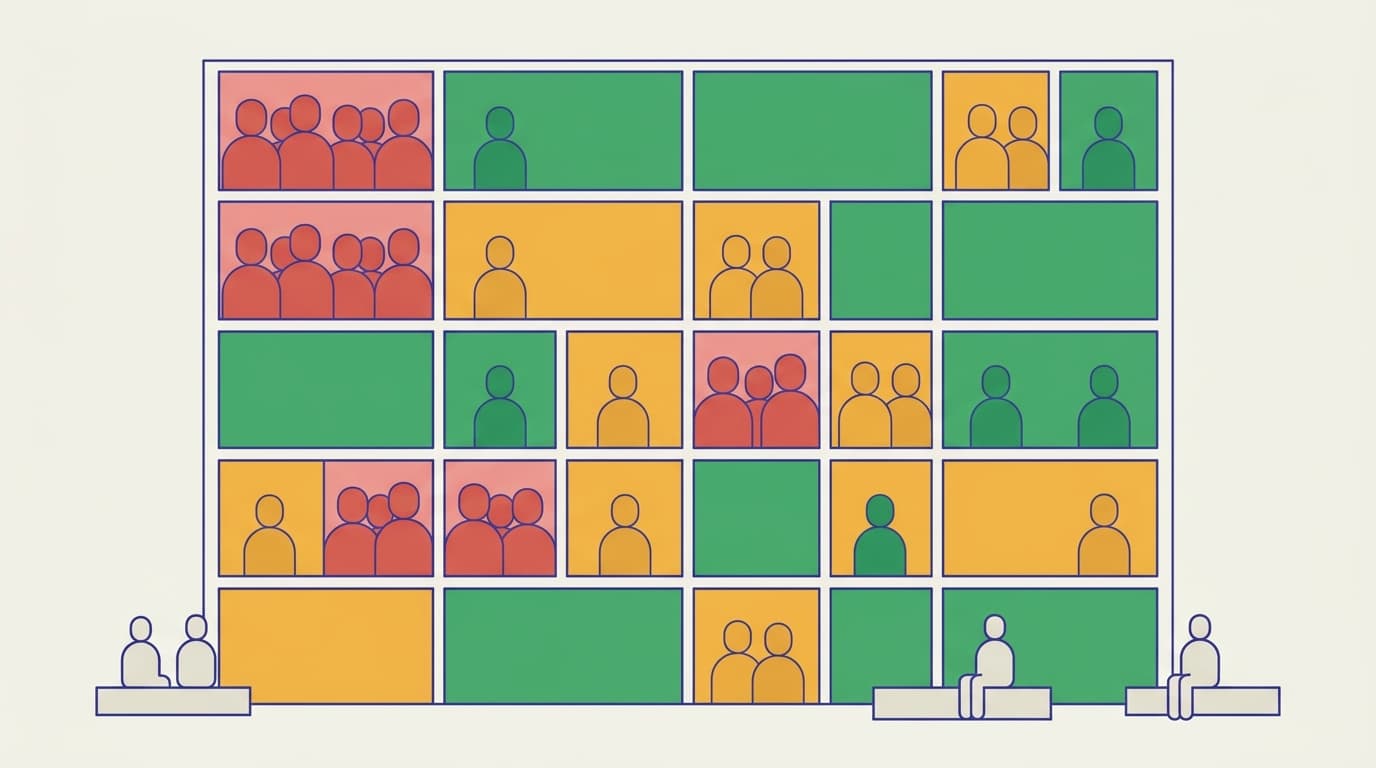
In 2026, Belgium's ten main parties pull two opposite levers in the face of full prisons. On one side, the N-VA, MR, Open VLD, CD&V and Vlaams Belang want to raise capacity and speed up administrative exits: new places, expulsion of convicted people without residence rights, detention abroad. On the other, the PS, Ecolo, Groen and the PTB·PVDA want to cut the number of entries: less pre-trial detention, fewer short sentences, more alternatives. Vooruit and Les Engagés mix both.
The disagreement is not about the diagnosis. Everyone accepts that a prison at 122% occupancy does not work. It is about where to act: at the exit of the pipe or at its entrance. One camp wants to enlarge the container, the other wants to close the tap. Both say they want liveable prisons and sentences that are actually served; they are simply not aiming at the same point of the system.
By the numbers, the situation has worsened. On 12 February 2026, Belgium counted 13,473 inmates for 11,049 places. In early April, 736 people were sleeping on a mattress laid on the floor, a record. And on 16 July the Chamber passed the Verlinden law, meant to take around 700 inmates out of the system. It is this gap — a law that relieves the equivalent of two months of growth — that shapes the debate.
How do you read these positions without taking sides?
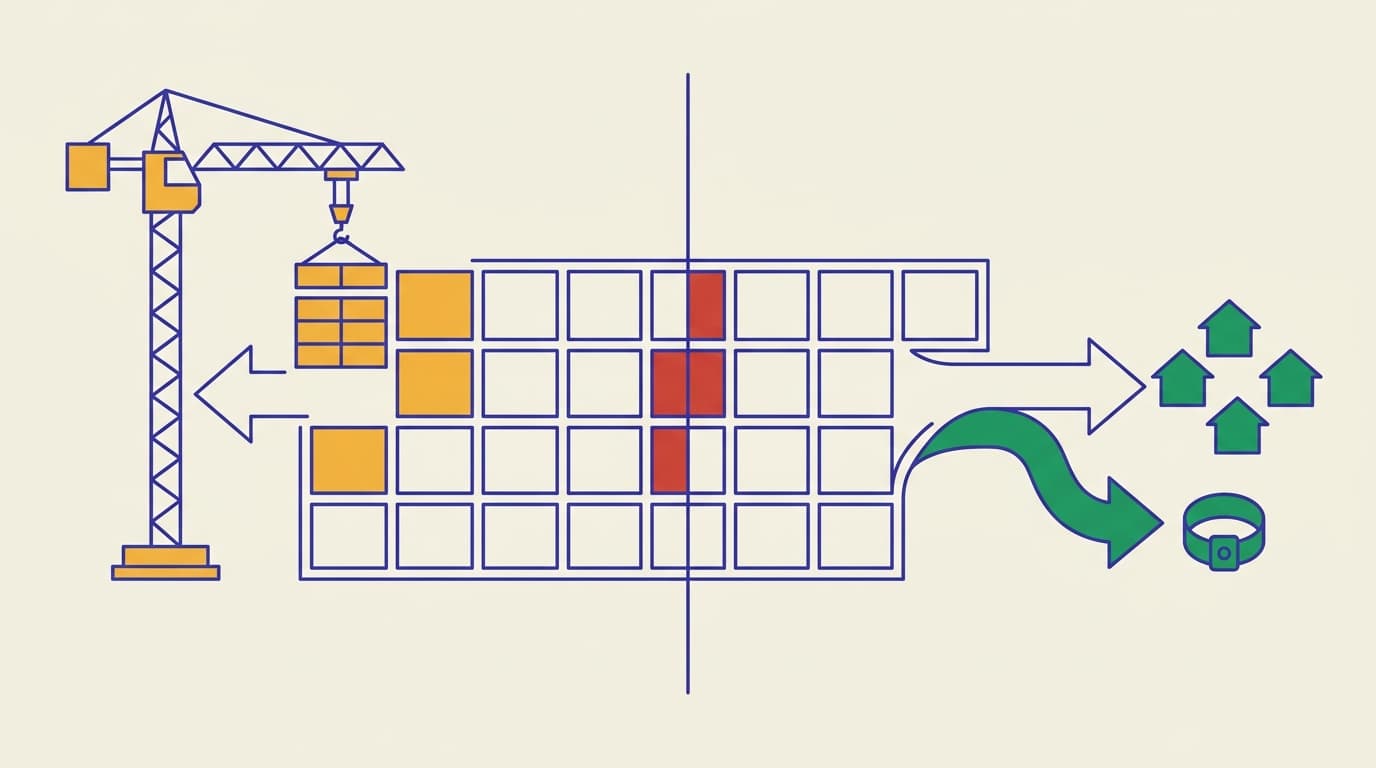
Each party gets a sign per lever here: a green + when it clearly backs that approach, an amber ~ for an intermediate or conditional position, a red − when it opposes it. This system replaces stars or marks out of 5, which would suggest a moral ranking.
No column designates a "good" party. A party marked with a + on capacity is often marked with a − on reducing entries, and vice versa. The two levers answer different priorities — that sentences handed down are actually served for one, that prison becomes a last resort again for the other — backed by different voters.
For example, the N-VA gets a + on capacity and administrative exits, and a − on reducing entries, which it equates with undermining the authority of court decisions. The PTB·PVDA has the opposite profile. Neither is "in the lead": they are not playing on the same field.
| Party | Raise capacity and speed up exits | Reduce the number of entries into prison |
|---|---|---|
| N-VA | + | − |
| Vlaams Belang | + | − |
| MR | + | ~ |
| Open VLD | + | ~ |
| CD&V | + | ~ |
| Vooruit | ~ | ~ |
| Les Engagés | ~ | + |
| PS | ~ | + |
| Ecolo | − | + |
| Groen | − | + |
| PTB·PVDA | − | + |
Why are Belgian prisons overflowing in 2026?
Prisons are overflowing because the inmate population is climbing far faster than capacity. Between 2016 and 2026, the number of inmates went from around 10,500 to nearly 13,800 at its peak, a rise of over 30%. Capacity, meanwhile, gained only 198 beds between 1 August 2025 and early 2026, moving from 10,844 to 11,042 places — while 621 additional inmates arrived.
That three-to-one ratio explains everything else. A bed built for three additional inmates never closes the gap, whatever the pace of construction. This is what RTBF summed up in June 2026 with its assessment of "30 years of figures, 30 years of failures": every prison plan since the 1990s has delivered places, and every time the inmate population has absorbed them.
In practice, the situation varies sharply from one facility to another. Lantin held 1,110 inmates for 744 places, Antwerp 714 for 439, Bruges 868 for 612, Hasselt 652 for 450. At those levels these are no longer shared cells, they are mattresses on the floor: 736 people in early April according to a union count. In June, prison governors referred the matter to the European Committee for the Prevention of Torture, which is rare and says much about the deadlock. A projection reported by La Libre on 15 June envisages 18,000 inmates in ten years if nothing changes on entries.
What does the Verlinden law passed on 16 July 2026 change?
The law brought by Justice Minister Annelies Verlinden (CD&V) acts on exits, not on entries. Adopted in the Chamber's plenary session on 16 July 2026, it targets around 700 fewer inmates, roughly the number of people currently sleeping on the floor.
Three main measures. Electronic monitoring becomes automatic for sentences of up to eighteen months, until end-2028, excluding high-risk profiles — terrorism, sexual offences, serious violence, drugs — and keeping the sentence-enforcement judge's oversight. Early releases on overcrowding grounds are extended until end-2027, but reserved for convicted people whose total sentences do not exceed three years. A fast-track expulsion procedure applies to convicted people without residence rights. The minister presents the text as "not a miracle solution, but a change of course".
The text's journey alone shows the resistance. Approved by the Council of Ministers on 22 May, it got the green light in the Justice committee in late June — with Claire Hugon (Ecolo-Groen) obtaining a second reading before the plenary. On 8 July, the sentence-enforcement courts asked for the bill to be withdrawn outright, judging automation incompatible with their duty of individual assessment. So a text that relieves prisons can be contested by the judges tasked with applying it — a situation that fits into no political camp.
What do the parties wanting more places and more expulsions propose?
Centre-right and right-wing parties want capacity to catch up with the population first, without touching the sentences handed down. The government's action plan provides for at least 1,300 extra places in the short and medium term: 607 in 2026, 420 in 2027, 275 in 2028, through new prisons, detention houses, modular units and forensic facilities. A task force is due to deliver further options by the end of 2026 on capacity, foreign nationals, interned persons, staff and enforcement of sentences.
This camp's second axis is the expulsion of inmates without residence rights. The MR publicly claims to have obtained the intensification of removals of foreign inmates from May 2026, with a target of at least 250 forced removals and 50 inter-state transfers. Since March, the Immigration Office can start an expulsion twelve months before the end of the sentence instead of six, or as soon as a third of the sentence has been served if the documents are in place. The Vlaams Belang goes furthest, calling for all non-Belgian inmates to be sent back to their country of origin, and obtained in April the figures that feed its position: 4,943 foreign inmates out of 11,123, over 44%. The N-VA, CD&V and MR also focus the debate on this point, and the government is exploring detention capacity abroad — missions to Albania and Kosovo are mentioned, with a European legal analysis under way.
The core argument is authority: a judge who hands down a sentence must see that sentence served, and a missing cell amounts to cancelling the decision. The opposing camp replies that thirty years of building have never closed the gap, and that the 1,300 announced places barely match a single year's growth. On foreign nationals, the Federal Institute for Human Rights, in an October 2025 note, points out that removing inmates without residence rights runs into concrete obstacles — identification, agreement of the country of origin, travel documents — which explain why the real figures stay far from the announcements. The 44% figure also covers very different situations, from the EU resident settled for twenty years to the inmate in transit.
What do the parties wanting to reduce entries into prison propose?
Left-wing parties want to act on the inflow rather than the stock. The PS backs alternative sentences raised to the rank of main sanctions, small detention houses and transition facilities, and stronger psychosocial support to cut reoffending. The PTB·PVDA argues for restorative and educational sanctions, and for specialised institutions for interned and drug-dependent people, who today occupy cells for want of an alternative. Ecolo and Groen call for a full change of logic: "We don't need new prisons but a radical change of approach", as Claire Hugon (Ecolo-Groen) put it in committee in late June.
Their main target is pre-trial detention and short sentences. The historical reminder they raise is awkward for several parties: it was the Vivaldi government — bringing together the PS, Vooruit, MR, Open VLD, Ecolo, Groen and CD&V — that decided in 2022 to systematically send to prison people sentenced to less than three years, whereas those sentences were previously served at home under electronic monitoring. That decision, taken by a coalition running from the left to the centre-right, mechanically inflated the prison population. It shows that no political family has entirely clean hands on this file.
The core argument is long-term effectiveness: a short sentence in an overcrowded prison desocialises, cuts off employment and housing, and raises the risk of reoffending, hence of return. The Penitentiary Council, in its opinion on overcrowding, points the same way, and criminologists quoted in the press stress preventing reoffending, rehabilitation and detention conditions rather than additional sanctions. The criticism, voiced by the right, is that a discourse of alternatives can be heard as giving up on punishment, and that alternative sentences require human follow-up — probation officers, psychosocial services — that is lacking today. The PS itself, in opposition, was harsh on the July law: "This agreement, which we had denounced, changes nothing", said Khalil Aaouasti (PS).
Where do Vooruit, Les Engagés and the CD&V stand?
These three parties blur the line because they sit in the Arizona coalition while coming from different families. The CD&V holds the Justice portfolio with Annelies Verlinden: hence its + on capacity and exits, since it carries the 1,300-place plan and the July law, and its ~ on entries, since the same text automates electronic tagging — a measure the left had called for and the hard right criticises.
Vooruit inherits a double ~. Socialist, it shares the attention to rehabilitation and small detention facilities; a member of the majority, it backed an agreement that toughens sentences and bets on building. It fully owns neither lever. Les Engagés lean towards reducing entries — hence their + — without contesting the capacity plan, hence their ~: the party has clearly shifted in recent years towards a public-health approach on drugs, which bears directly on entries into prison.
These pivot positions are a reminder that a left-right axis is not enough. The Open VLD, in the federal opposition but liberal, joined the PTB and Ecolo-Groen in denouncing measures deemed "symbolic" with no real deterrent effect — an unlikely alliance, showing that the same text can be criticised for diametrically opposed reasons: too lax for some, too cosmetic for others.
Build or decarcerate: what do the votes say?
The 2026 votes confirm the dividing line, with a nuance. The Arizona majority — N-VA, MR, Vooruit, CD&V, Les Engagés — passed the Verlinden law on 16 July and carries the 1,300-place plan. The PS, Ecolo, Groen and the PTB·PVDA voted against or criticised the text, but not for the same reasons as the Vlaams Belang, which on the contrary deems any early release unacceptable.
Testing promises against actions remains the best antidote to electoral marketing. Every party says it wants "decent prisons"; it is the prison budgets, the texts voted and the 2022 decisions on short sentences that reveal the lever actually pulled. The July law is telling: a government of firmness passes early releases, because the physical space is missing. Physical constraint ends up imposing its choices, whatever the stated line.
To dig further, the comparator lets you put two parties side by side on justice, the ranking sums up positions theme by theme, and the quiz starts from your priorities rather than a manifesto. The methodology details how these positions are gathered and remains open to challenge.
What this comparison does not settle
This table does not say which lever works best. The real effect of a place built or of an alternative sentence depends on the number of prison and probation officers, the length of building works, the reoffending rate, prosecution policy and social factors that go well beyond criminal law. Nor does it factor in your experience — victim, neighbour of a future prison site, professional on the ground, relative of an inmate — which often weighs more than a national average.
So the right reflex is not to remember a winning camp, but to link each position to the lever it pulls, then to test this overview against what you expect from a prison policy.
Sécurité & Justice comparator
Compare the parties' positions on sécurité & justice.
Compare now →
Frequently asked questions
Camille est politologue, diplômée en sciences politiques de l'UCLouvain. Elle a suivi trois campagnes électorales belges comme analyste et décortique depuis dix ans les programmes des partis, vote par vote. Sur Meilleur Parti Politique, elle traduit le jargon politique en comparaisons concrètes — sans jamais dire pour qui voter.