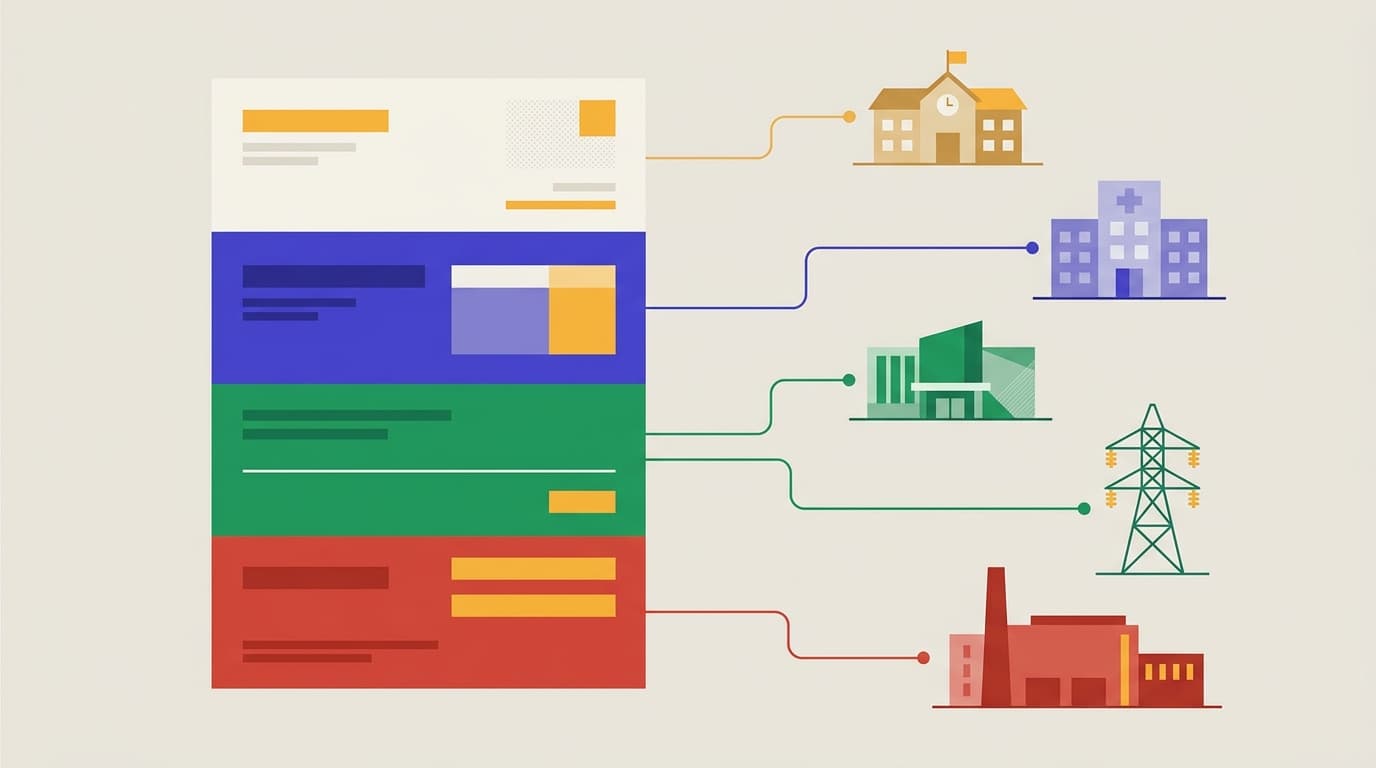
Who sets the price of electricity in Belgium?
Nobody, on their own.
The figure at the bottom of your bill is the sum of four decisions taken separately by actors who do not coordinate: a private supplier freely sets the energy component, the CREG (the federal energy regulator) approves the transmission tariff, your Region's regulator approves the distribution tariff, and both the federal state and the Region add their levies. No minister signs that total.
The distinction matters before comparing party programmes. Depending on which lever a party promises to pull, it is addressing a level of government that is not necessarily the one where it sits.

Which part of the bill depends on which level of government?
The CWaPE, the Walloon energy regulator, distinguishes four groups of costs on a settlement bill. Here is who decides what, and on what basis.
| Bill component | Who decides | Basis of the decision |
|---|---|---|
| Energy (price per kWh, fixed fee) | The supplier, freely | Market liberalised for households since 2007 |
| Transmission tariff (high-voltage grid) | The CREG, federal regulator | Multi-year tariff methodology applied to Elia |
| Distribution tariff (local grid) | The regional regulator: CWaPE, BRUGEL or VREG | Exclusive regional competence since 1 July 2014 |
| VAT, energy contribution, special excise | The federal authority | Statute and programme law, tax orders |
| Connection charge, regional surcharges | The Region | Decree or ordinance, feeding a regional fund |
| Social tariff | The CREG for the amount, the FPS Economy for beneficiaries | Quarterly calculation on the lowest offers |
The table settles a common confusion. A VAT cut is a matter for a federal majority, action on local grid costs a matter for a regional parliament. Bringing down the price per kWh itself, on the other hand, is neither: that price comes from a commercial contract.
The supplier freely sets the energy component
It is the only part exposed to competition. So the only one where switching contracts has an immediate effect.
According to the CREG, this component accounts for roughly 30 % to 40 % of a typical residential bill. The rest is regulated or fiscal. A household that optimises its contract is therefore acting on a little more than a third of what it pays.
Who approves grid costs?
Two different regulators, and this is where Belgium's institutional geography shows most clearly.
Transmission, meaning delivery from generation sites across Elia's high-voltage grid, falls to the CREG. On 14 November 2023 it approved Elia's tariff proposal for the 2024-2027 regulatory period, with a budget 10 % below the operator's initial request and an announced average increase of 77 % over the four years, backed by a 6.4 billion euro investment programme. That figure has circulated as if it applied to the whole bill, when it covers a single component.
Distribution changed hands. With the sixth state reform, tariff competence passed from the federal level to the Regions on 1 July 2014. Since then the CWaPE approves the tariffs of Walloon operators, BRUGEL those of Sibelga in Brussels, and the VREG those of Fluvius in Flanders. Two identical households separated by a regional border therefore pay grid tariffs set by two distinct authorities.
Brussels shows what these decisions weigh. Under the tariff methodology approved by BRUGEL for 2025-2029, the capacity tariff rose from 27.38 euros in 2024 to 41.41 euros in 2025, then 47.24 euros in 2026, and the metering tariff from 15.45 to 23.54 euros. These amounts are not taxes. They are regulated tariffs, set by an authority nobody elects.
Which taxes does the federal state levy on electricity?
Three, and one of them vanished from bills without leaving your wallet.
VAT on residential electricity fell to 6 % in March 2022, first as a temporary measure, then permanently on 1 April 2023. The trade-off, decided by the federal government in February 2023, is an excise duty reform with a ratchet mechanism. When market prices exceed a ceiling, the excise on the first consumption bracket falls, with a possible adjustment each quarter.
The energy contribution is earmarked for the fund that balances social security financing.
The special excise duty is an addition of former levies. Since 1 January 2022, under the programme law of 27 December 2021, it absorbs the old federal contribution, which funded the CREG's operating costs, denuclearisation, public service obligations entrusted to the public social welfare centres, the social tariff, and the surcharges tied to offshore wind and strategic reserves. The 'federal contribution' line has therefore disappeared from bills without the levy disappearing.
What does your Region levy?
Less than the federal state, and largely invisibly.
In Wallonia, the only identifiable regional line is the grid connection charge, paid into the regional Energy Fund, which finances the regulator itself, rational energy use measures, renewables promotion and social energy guidance by the public social welfare centres. Two further levies exist without ever appearing as a separate line, because they are built into transmission and distribution tariffs: the renewables support surcharge, which funds part of the Walloon green certificates, and the road levy paid to municipalities.
Four misreadings of a bill come up regularly, and each one assigns an increase to the wrong decision-maker:
- taking the distribution tariff for a tax: it is a regulated tariff approved by a regional authority, not a levy voted by a parliament;
- believing the federal contribution was abolished in 2022: it was folded into the special excise duty, not scrapped;
- attributing the rise in transmission tariffs to a government: it follows a CREG decision on a multi-year methodology;
- treating the social tariff as a negotiated commercial rate: its amount is set by the federal regulator and is identical at every supplier.
Who sets the social tariff, and who grants access to it?
Two authorities, and they are worth separating.
The CREG sets the amount of the social tariff every quarter. It calculates it from the lowest price per kWh offered on the market in the previous quarter, the lowest distribution costs in Belgium and the lowest transmission costs. In the first quarter of 2026, that tariff rose by 9 % for electricity and fell by 4.9 % for natural gas.
Access does not depend on the regulator. The FPS Economy draws up the list of beneficiaries and sends it to suppliers every three months. A regulator sets the price; an administration decides who qualifies.
Which level should you look at when comparing energy programmes?
The one holding the lever in question, and it changes from one sentence to the next.
A measure on VAT or excise duties is decided federally. A measure on distribution tariffs, green certificates or renovation grants is decided regionally. A measure on the price per kWh itself is decided nowhere by authority, short of changing the framework of the liberalised market, which is another debate and is partly played out at European level. Party positions on these levers are collected in the climate and energy section, and energy taxation is handled separately in our comparison of energy taxes. The comparator puts two parties side by side; the scores in the ranking express a position on an axis, never a quality or a merit table, and the methodology explains how they are built.
One last reflex, useful when a figure starts circulating. Before concluding that an increase is down to a given government, open your regional regulator's page on bill components and the structure of Belgian public authorities on the federal portal. Often, the line that moved belongs to a level of government nobody mentioned in the debate.
Climat & Énergie comparator
Compare the parties' positions on climat & énergie.
Compare now →
Frequently asked questions
Camille est politologue, diplômée en sciences politiques de l'UCLouvain. Elle a suivi trois campagnes électorales belges comme analyste et décortique depuis dix ans les programmes des partis, vote par vote. Sur Meilleur Parti Politique, elle traduit le jargon politique en comparaisons concrètes — sans jamais dire pour qui voter.