A Region and a Community: what actually separates them?
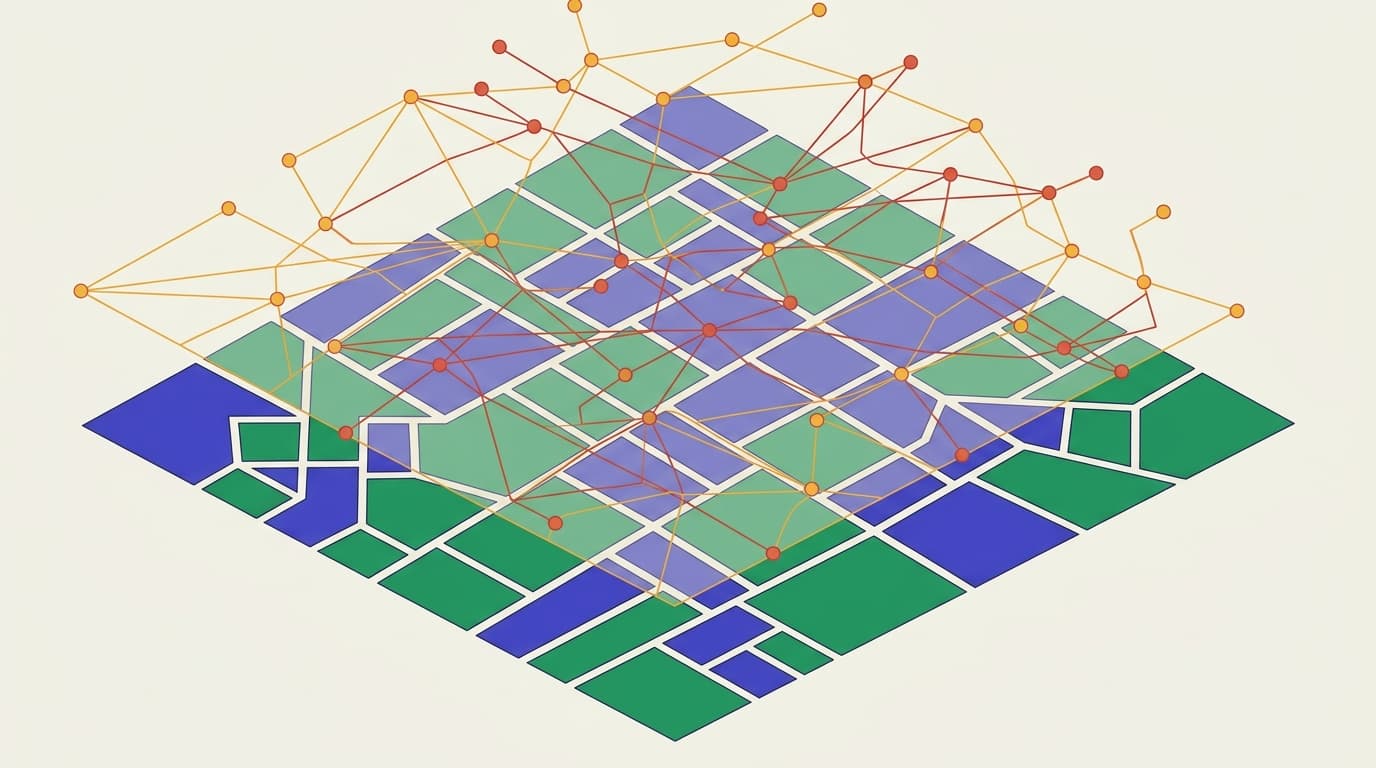
A Region runs a territory, a Community runs people. That is the whole distinction, and it explains nearly everything else: Regions decide what is attached to the ground — the economy, housing, the environment, roads — while Communities decide what is attached to people and their language — schools, culture, welfare services.
Article 1 of the Constitution puts it in one line: « Belgium is a federal State made up of Communities and Regions. » Article 2 names the three Communities — French, Flemish, German-speaking. Article 3 names the three Regions — Walloon, Flemish, Brussels. Six entities, two logics, one country.
The practical consequence shows up on any street in Namur. The school at the end of the road depends on the French Community; the pavement in front of it, on the Walloon regional budget; the train passing behind it, on the federal authority. Three levels of power within a hundred metres, and no sign anywhere to say so.

Why did Belgium end up with both?
Because two different demands were granted at the same time. This is the standard reading of Belgian federalism, the one found in the work of CRISP (an independent Brussels research centre on political and social affairs) and in institutional history: by the late 1960s, the Flemish movement was primarily asking for cultural and linguistic autonomy, while the Walloon movement was primarily asking for economic autonomy, in an industrial region then in decline. The first demand called for entities based on language. The second, for entities based on territory.
The 1970 constitutional revision did not choose between them: it created the cultural Communities and laid down the principle of Regions, leaving later reforms to actually build them. It took until 1980 to give Regions and Communities their own institutions, until 1988-1989 to transfer education to the Communities and create the Brussels Region, and until 1993 for Article 1 to finally describe the State as federal. Six state reforms in total, spread over more than forty years, each adding a layer without demolishing the previous one — hence an architecture nobody would have drawn in one go on a blank page.
The objection deserves to be stated, and it regularly is in Belgian debate: this duality is a legacy of compromise, expensive and hard to read, which a four-entity — or two-entity — territorial structure would have avoided. Defenders of the current model reply that it is precisely this double layer that has guaranteed cultural rights to linguistic minorities where they are not a territorial majority, above all to Dutch-speakers in Brussels. This site does not settle that debate, which is a political trade-off rather than a technical question; party positions on state reform are listed in the institutions section.
Who decides what, in practice?
Here is the split, matter by matter, as it follows from the Constitution and the special institutional reform acts. It is this table, more than the definitions, that answers the question people actually have: who do I write to when something goes wrong.
| Everyday matter | Level in charge | Useful detail |
|---|---|---|
| Schools, colleges, universities | Communities | Except three federal carve-outs (Art. 127): the bounds of compulsory schooling, minimum diploma conditions, staff pensions |
| Culture, libraries, public broadcasting | Communities | RTBF on the French-speaking side, VRT on the Flemish side |
| Welfare services, health policy, childcare | Communities | Partly exercised by the Walloon Region and COCOF since 1 January 1994 |
| Employment, economy, business support | Regions | |
| Housing, spatial planning, urban development | Regions | |
| Environment, water, energy, climate | Regions | |
| Roads, regional public transport, public works | Regions | TEC, STIB, De Lijn — but the railways are federal |
| Municipalities and provinces (oversight) | Regions | |
| Social security, statutory pensions, personal income tax | Federal authority | |
| Justice, federal police, defence, foreign affairs | Federal authority |
One detail changes how the table should be read: the Belgian split works through exclusive competences. Once a matter is assigned to a level, the others may no longer legislate on it — unlike federations where the central State keeps the final word. That is why there is no federal minister for education, and why agreement between entities goes through an internal treaty, the cooperation agreement, rather than a decision from above.
Exclusive does not mean watertight, though. Climate, energy and public health straddle several levels, which explains the proliferation of inter-ministerial conferences and of the Comité de concertation (Consultative Committee), the body where the federal government and the federated entities look for agreement when their competences touch.
How many parliaments and governments does that produce?
Six of each, in 2026.
| Entity | Assembly | Seats |
|---|---|---|
| Federal authority | Chamber of Representatives | 150 (+ Senate, 60) |
| Flemish Community and Region (merged) | Flemish Parliament | 124, including 6 elected in Brussels |
| French Community (Fédération Wallonie-Bruxelles) | Parliament of the FWB | 94, not directly elected |
| Walloon Region | Walloon Parliament | 75 |
| Brussels-Capital Region | Brussels Parliament | 89 |
| German-speaking Community | Parliament of the German-speaking Community | 25 |
The Parliament of the French Community is the only one nobody elects: its 94 members are the 75 Walloon MPs plus 19 French-speaking members of the Brussels Parliament. You never vote « for the Fédération Wallonie-Bruxelles » — its composition is a by-product of two other elections, which explains part of its low public profile.
The scale of the smallest level is worth spelling out, because it surprises people even in Belgium. On 1 January 2025, the nine German-language municipalities had 79,537 inhabitants, that is 2.1 % of the Walloon population, across 846 km², according to IWEPS, the Walloon statistics institute. That Community nonetheless has its own parliament, its own government and its own schools, exactly like the other two.
The objection: in Flanders, the distinction is gone
It was removed back in 1980. The Flemish Community and the Flemish Region merged their institutions: one parliament, one government, one minister-president for both. A Flemish voter therefore never sees the duality this article describes.
Brussels, where the two logics really meet
Brussels is where the system shows both its value and its cost. The territory of the bilingual Region falls under the French Community and the Flemish Community at the same time, with neither « owning » the city. A Brussels resident does not legally belong to a Community: they choose, school by school, hospital by hospital, theatre by theatre, the French-speaking or Dutch-speaking institution they deal with. Competence follows the establishment, not the person — the only way to run two complete school systems side by side on 162 km².
Three community commissions extend that arrangement locally: COCOF for French-speaking institutions, VGC for Dutch-speaking ones, and COCOM (in Dutch, GGC) for everything bicommunal — a public hospital, a CPAS/OCMW welfare office, a care home belonging to neither. COCOM, incidentally, passes ordinances too, like the Brussels Parliament.
The Walloon counterpart to that flexibility is less well known. Following the Saint-Quentin agreement of 31 October 1992 and the decrees of July 1993, the French Community transferred the exercise of part of its competences — support for people with disabilities, policy for the elderly, tourism, sports facilities, school transport — to the Walloon Region and to COCOF, with effect from 1 January 1994. As a result, several matters that are « Community » on paper are run by the Region in practice in Wallonia, which makes the dividing line blurrier than any textbook suggests.
Decree, ordinance, act: same force, different review
One and the same rank of legal norm goes by three names depending on who adopts it. The federal Parliament passes acts (lois/wetten), Community and Regional parliaments pass decrees, and the Brussels Parliament and the United Assembly of COCOM pass ordinances. In principle all of these carry the same value: they can amend or repeal existing legislation in their field.
The exception concerns the ordinance. According to CRISP, the ordinary courts and the Council of State may refuse to apply an ordinance they consider contrary to the Constitution or to the special law of 12 January 1989 — a review that exists neither for federal acts nor for decrees, which are subject only to the Constitutional Court. Brussels therefore legislates with a slightly more fragile instrument than its neighbours.
The most frequent mix-ups fit into five lines, and they all come down to confusing territory with language:
- confusing the Fédération Wallonie-Bruxelles with the Walloon Region: the first also covers French-speakers in Brussels, the second stops at the Walloon border;
- assuming Wallonia runs the schools: that is the French Community, except for school buildings and school transport, transferred in 1994;
- assuming the Flemish Community has nothing to do with Brussels: it funds Dutch-speaking schools, libraries and cultural centres there;
- calling a text of the Brussels Parliament a decree: it is an ordinance, and the judicial review is not the same;
- treating the German-speaking Community as a region: it has no territory of its own within the meaning of Article 3, and its nine municipalities remain part of the Walloon Region.
What the duality changes when you vote
Mostly, it changes who receives your ballot. On a single regional election day, a Walloon voter elects the Walloon Parliament and, indirectly, part of the Parliament of the French Community; a Brussels voter elects the regional Parliament and, depending on their language group, contributes to the composition of the FWB or of the Flemish Parliament. The competences that vote weighs on — schools on one side, housing on the other — are not the same.
That is worth checking before comparing manifestos. A party promising education reform commits to nothing if it only sits at regional level; a promise on rents makes no sense in a Community election. The comparator puts two parties side by side theme by theme, the ranking summarises positions by topic, and the methodology explains how those positions are collected and where it remains open to challenge. These rankings describe a position on an axis, never a level of quality.
One last pointer. The official split between levels of power is published and kept up to date on the federal portal belgium.be, and the electoral organisation of these six assemblies is set out by the FPS Home Affairs. When a debate turns on « who should have acted », those are the two pages to open before drawing a conclusion.
Institutions comparator
Compare the parties' positions on institutions.
Compare now →
Frequently asked questions
Camille est politologue, diplômée en sciences politiques de l'UCLouvain. Elle a suivi trois campagnes électorales belges comme analyste et décortique depuis dix ans les programmes des partis, vote par vote. Sur Meilleur Parti Politique, elle traduit le jargon politique en comparaisons concrètes — sans jamais dire pour qui voter.