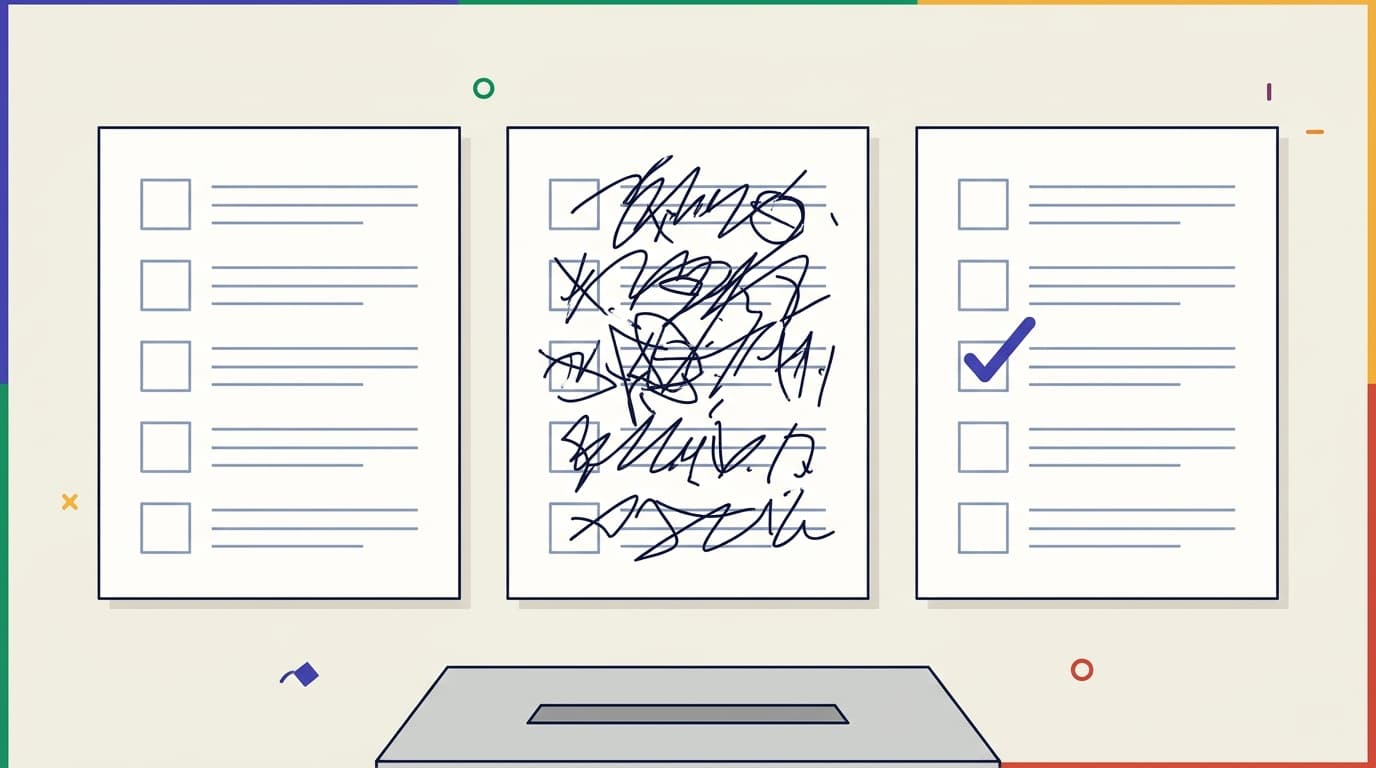
A blank ballot is cast with no mark; a spoiled ballot (« bulletin nul », or null ballot) carries a mark the law does not accept. The two are counted together, neither goes to any list, and both differ from abstention, the only one of the three that exposes you to a penalty.
On 9 June 2024 they made up 416,577 ballots for the Chamber, or 5.6% of the ballots cast.

Blank, spoiled, abstention: the three cases side by side
In everyday conversation the three get mixed up. In law and in the results they have almost nothing in common.
| Criterion | Blank ballot | Spoiled ballot | Abstention |
|---|---|---|---|
| Definition | ballot cast empty | ballot marked in a way not allowed (drawing, text, votes spread across lists) | not turning up, with no proxy |
| Counts as turning up? | yes, the SPF Intérieur says you may leave your ballot blank | yes, according to La DH it is not an offence | no |
| Counted among valid votes? | no | no | not applicable |
| In the official statistics | shared « blancs ou nuls » line | shared « blancs ou nuls » line | derived: registered voters minus ballots cast |
| Effect on seat allocation | none | none | none |
| Possible penalty | none | none | reprimand or fine; removal from the voter list after four unjustified absences in fifteen years |
The sources consulted give different fine amounts, which is why this table carries no euro figure.
What separates a blank ballot from a spoiled one?
The blank ballot contains nothing. L'Avenir describes it as a ballot that « reste entièrement vierge » (stays entirely empty): the voter came, took the ballot, and chose neither a list nor a candidate.
The spoiled one is marked in a way the law does not recognise. The Belgian press cites three typical cases:
- a drawing on the ballot;
- an insult or a written text;
- votes spread across several different lists, known as panachage between lists.
Not every spoiled ballot is deliberate. Jérémy Dodeigne, a political science professor at UNamur quoted by L'Avenir, sees the spoiled vote as an intentional protest against the electoral process or representative democracy. The researcher Geoffrey Pion, in a 2010 study summarised by Wikipedia, sorts spoiled ballots into four families: handling errors, crossed-out ballots, protest against politics, and text unrelated to politics. A spoiled ballot can therefore be a gesture or a slip, and the count does not tell them apart.
Does a blank or spoiled ballot change the seats?
No. Seats are allocated by the D'Hondt method (a proportional formula explained in our guide) from the valid votes of each constituency only, and neither blank nor spoiled ballots are among them. Removing these ballots or adding a thousand moves no seat.
The denominator of the percentages, though, does move. Take one hundred ballots cast: 40 for list A, 25 for B, 15 for C and 20 blank or spoiled. Valid votes are 80, list A weighs 50% of them but only 40% of the ballots cast. Same list, same number of votes, two percentages.
The calculation can be checked on the real election. In 2024, valid votes for the Chamber were 6,984,906, and 5% of that total is 349,245 votes. Set against the 7,401,483 ballots cast, those 349,245 votes are 4.72%. A list at 4.72% of ballots cast therefore reached exactly 5% of valid votes. The example is national and illustrative; the threshold itself is measured constituency by constituency, as our article on the 5% electoral threshold explains.
The effect of blank and spoiled ballots is on percentages, never on seats.
416,577 ballots with no list on 9 June 2024
The table below takes the official results page for the Chamber for the 9 June 2024 election. The shares in the last column were calculated for this article.
| Chamber, 9 June 2024 | Number | Share |
|---|---|---|
| Registered voters | 8,368,029 | 100% |
| Ballots cast | 7,401,483 | 88.4% of registered voters |
| of which blank or spoiled | 416,577 | 5.6% of ballots cast |
| of which valid votes | 6,984,906 | 94.4% of ballots cast |
| Registered voters with no ballot cast | 966,546 | 11.6% of registered voters |
Added together, registered voters with no ballot and those who cast a blank or spoiled one come to 1,383,123 people, or 16.5% of registered voters. RTBF put a comparable grouping for 2019 at 1.3 million voters, 17%. According to Wikipedia, blank and spoiled ballots were 5.2% of ballots cast in 2003, a similar order of magnitude to 2024.
Two caveats. The official page does not split blank from spoiled. And the press has published other abstention figures: BX1 reported the day after the vote more than 1,050,000 voters, or 12.5% of the electorate, against 966,546 from the subtraction above. The sources consulted do not explain the gap.
Two readings of what a blank ballot is for
Commentators are not answering the same question. Some describe a calculation, others a signal, and the two readings coexist without excluding each other.
The first is arithmetic. RTBF and L'Avenir observe that these ballots leave the total of valid votes and therefore mechanically raise each list's percentage, which brings the strongest list closer to a majority of valid votes. RTBF concludes that they tend to strengthen the largest party, even though many of those casting them are voicing criticism of the big parties. Seats, remember, do not move. Other systems treat these ballots differently: again according to RTBF, they go to the winner in Greece, and count towards thresholds but not towards seats in the Netherlands and Spain.
The second is symbolic. Blank and spoiled ballots are counted, entered line by line in the official minutes and published with the results; the SPF Intérieur's instructions to counting bureaus even provide for an extra check when their share looks high. The Blanco party, created for the 2024 elections, proposes going further: these votes would produce « sièges non attribués » (unallocated seats), held by members who would vote neither for nor against bills. According to La DH, the party itself puts at 30 out of 150 the number of Chamber seats concerned. That option does not exist in current law.
On a screen, a blank vote exists, a spoiled vote does not
The SPF Intérieur writes that the voter « peut également exprimer un vote blanc » (can also express a blank vote). RTBF and La DH add that a spoiled vote is impossible on a screen, since the voter cannot step outside the boxes. Electronic voting is used in 152 Flemish municipalities, in all 19 Brussels municipalities and in the 9 German-speaking municipalities, plus 4 mixed municipalities that combine screen and paper. Elsewhere, the ballot is on paper.
What do you risk by abstaining?
The risk is written into the law, but La Libre states that no citizen has been penalised for an unjustified abstention since 2003. Article 62 of the Constitution says that « le vote est obligatoire et secret » (voting is compulsory and secret). Voting blank or spoiled meets the obligation to turn up; not turning up, without an excuse or a proxy, does not.
A juge de paix (justice of the peace) can summon an absent voter. If the explanation is not well founded, the case can go to the tribunal de police (police court), whose decision, La Libre notes, cannot be appealed. A first unjustified absence exposes the voter to a reprimand or a fine, a repeat offence to a heavier fine, and four unjustified absences in fifteen years can lead to removal from the voter lists for ten years, according to La DH and La Libre. The two papers do not give the same amounts, and neither cites the article of law; check them with the SPF Intérieur before quoting them.
An impediment is settled by a letter to the juge de paix with supporting documents or, in advance, by a proxy: our guide to proxy voting details the seven grounds. In Flanders, the obligation was lifted in 2024 for municipal and provincial elections, which changes nothing for the Chamber or the European Parliament. The debate on the obligation itself, with each party's position, is in our compulsory voting comparison.
None of these three gestures tells you who to vote for, and this site does not either. Party positions are compared, without hierarchy, in the comparator; the scores there reflect a position on an axis, not a quality, as the methodology explains.
Sources: SPF Intérieur, Le vote est-il obligatoire ? and Le vote électronique; Official results, Chamber, 9 June 2024; Belgian Constitution, article 62; Wikipedia, Vote blanc; RTBF, 29 April 2024; L'Avenir, 6 June 2024; La DH, 7 June 2024; La Libre, 8 June 2024; BX1, 10 June 2024. The shares in the results table and the threshold calculation were redone for this article from the official figures.
Institutions comparator
Compare the parties' positions on institutions.
Compare now →
Frequently asked questions
Camille est politologue, diplômée en sciences politiques de l'UCLouvain. Elle a suivi trois campagnes électorales belges comme analyste et décortique depuis dix ans les programmes des partis, vote par vote. Sur Meilleur Parti Politique, elle traduit le jargon politique en comparaisons concrètes — sans jamais dire pour qui voter.