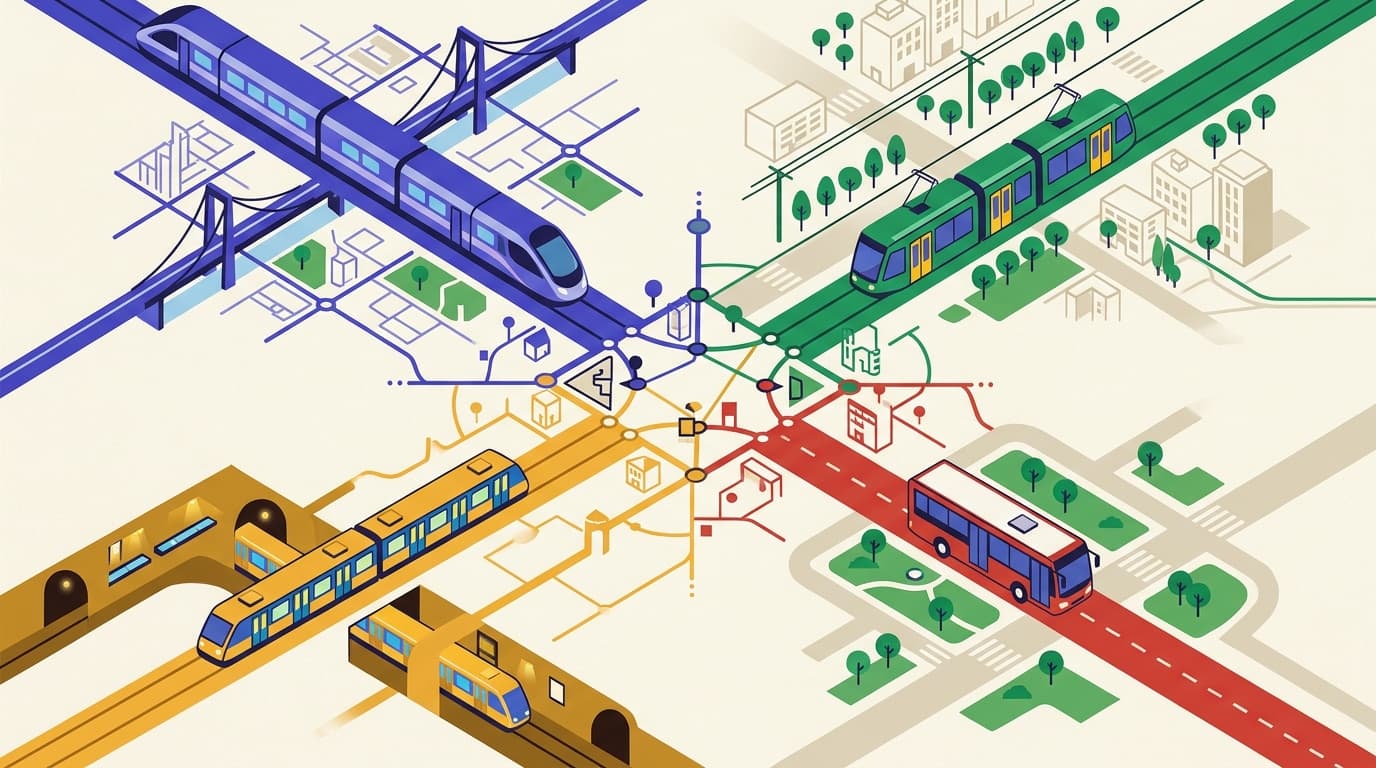
Belgium does not have one public transport network but four public operators, each tied to a different authority. Trains answer to the federal state. The Brussels metro, the Flemish bus and the Walloon bus each answer to a Region. A single ticket covers all four, in a limited zone around Brussels.
Four operators, four authorities
For a passenger, it all looks like one public service. In law, it is four separate files, each with its own minister, parliament and contract.
| Operator | Network | Deciding authority | Reference text or contract |
|---|---|---|---|
| SNCB (rail) | Trains, nationwide | Federal state, through its supervising minister | Public service contract 2023-2032, mission directly entrusted for ten years |
| STIB | Metro, tram and bus in Brussels | Brussels-Capital Region | Ordinance of 22 November 1990, five-year management contract (situation described in 2003) |
| De Lijn | Bus and tram in Flanders | Flemish Region | 2019 decree on "basisbereikbaarheid" (basic accessibility) |
| TEC (OTW) | Bus and the Charleroi light metro, in Wallonia | Walloon Region | Decree of 29 March 2018, Wallonia-OTW public service contract 2024-2028 |
Why does rail fall to the state and buses to the Regions?
The special law of 8 August 1980 gives the Regions "urban and local public transport, including specialised scheduled services". The Constitutional Court quotes this text in its judgment no. 117/2010 and sets its limits: the federal authority remains competent for non-scheduled services, such as occasional coach trips, for access to the profession and the market, and, according to a Council of State opinion that the Court reports, for scheduled cross-border services.
Rail follows a different logic. The judgment does not deal with SNCB, and I found no provision that spells it out. The document available is the contract: the federal government decided to entrust SNCB directly with the public service mission of domestic passenger transport, for ten years, as SNCB announced in December 2022.
Who decides on a bus route, a frequency, a timetable?
The answer changes with the Region, and so does the vocabulary.
In Wallonia, the Transport Organising Authority (Autorité organisatrice de transport), part of the Public Service of Wallonia, turns the government's vision into accessibility policy and plans the network. Operation falls to the OTW, which groups five directorates under the TEC brand: Walloon Brabant, Charleroi, Hainaut, Liège-Verviers, Namur-Luxembourg. The decree of 29 March 2018 reformed this governance, according to the Union of Walloon Towns and Municipalities. On-demand transport, coordinated by the Public Service of Wallonia, relies on around 600 operators, a third of them public (social welfare centres, municipalities, municipal agencies), and on a single call number.
In Flanders, the 2019 decree rests on fifteen "vervoerregio's" (transport regions), each with a regional mobility plan looking to 2030. The fifteen plans were approved between late 2023 and mid-2024, according to the Flemish portal. De Lijn runs buses and trams, and the "flexbus" in low-demand areas, which must be booked in advance.
In Brussels, a study by the European Metropolitan Transport Authorities platform described in 2003 a regional minister as the organising authority, who negotiates STIB's management contract, approves route changes and sets fare policy. I found no more recent description of this split.
Municipalities carry little weight, but not in the same way
- In Wallonia, each municipality holds one category B share. That share gives it the right to appoint a representative to the consultation body of its mobility area, which meets twice a year. Since the reform that took effect in December 2024, the municipal executive (collège communal) issues taxi licences. A municipality can also co-fund a "proxibus": it pays the driver, the OTW provides the bus and the training.
- In Flanders, municipal mobility plans have no longer been compulsory since the decree took effect. Municipalities may adopt one.
- In Brussels, the 19 municipalities act through urban planning, parking and roads, with no transport competence, according to the 2003 study.
Who pays for public transport?
Each authority funds its own operator, so there is no common budget. The figures below cannot be compared with one another: they do not share a scope or a year.
For rail, the funding for 2023 to 2032 was set by decisions of the Council of Ministers on 20 July 2022 and by the budget conclave of October 2022. The SNCB page consulted gives no amount. In Wallonia, the daily La Libre headlined on 23 December 2023 that TEC's annual grant rose to 987 million euros in the new public service contract, whose objective is to raise the share of public transport from 4% to 10% by 2030. In Brussels, the Region covered around two thirds of STIB's costs in 2003, according to the same study.
For Flanders, I found no recent sourced figure. I therefore give none.
One ticket for four networks: what is the Brupass XL?
The Brupass XL is a single ticket, at one fare, valid on STIB, TEC, De Lijn and SNCB. BX1 announced it on 17 January 2021 for 1 February, with the agreement of the regional governments, the federal government and the transport companies. The zone reaches 11.5 km around the 19 Brussels municipalities, airport excluded.
Here are the launch fares, with a calculation I redid from them. They date from 2021: check current prices before relying on them.
| Ticket | Launch price | Calculation |
|---|---|---|
| Single trip | €3 | Reference |
| 10 trips | €20 | €2 a trip, one third less than the single trip |
| Monthly pass | €74 | Cheaper than a single trip bought 25 times (€75) |
| Annual pass | €775 | €113 less than twelve months at €74 (€888), or 12.7% |
Lines that cross a regional border
De Lijn and TEC buses entering Brussels rest on an inter-regional agreement of 17 June 1991, according to the same 2003 study. It governs lines crossing Region boundaries. For national borders, the Constitutional Court, citing the Council of State, sees a federal competence.
Which election for which network?
The level of decision determines the election. Rail depends on the federal government, which comes out of the elections to the Chamber. STIB, De Lijn and TEC depend on regional governments, which come out of the regional elections. A proposal about the Walloon bus is therefore not debated in the same place as a proposal about SNCB.
Party positions on mobility are laid out, without ranking, in the mobility comparison and in the comparator. Theme scores describe a position on an axis, not a quality, as the methodology explains. To understand why competences are split this way, see the difference between Regions and Communities.
Sources: Constitutional Court, judgment no. 117/2010; SNCB, public service contract 2023-2032; UVCW, organisation of public transport in Wallonia; Wikipedia, Opérateur de transport de Wallonie; Vlaanderen.be, basisbereikbaarheid; BX1, single ticket, 17 January 2021; La Libre, 23 December 2023; EMTA, integration case study of the Brussels region, 2003.
Mobilité comparator
Compare the parties' positions on mobilité.
Compare now →
Frequently asked questions
Camille est politologue, diplômée en sciences politiques de l'UCLouvain. Elle a suivi trois campagnes électorales belges comme analyste et décortique depuis dix ans les programmes des partis, vote par vote. Sur Meilleur Parti Politique, elle traduit le jargon politique en comparaisons concrètes — sans jamais dire pour qui voter.